

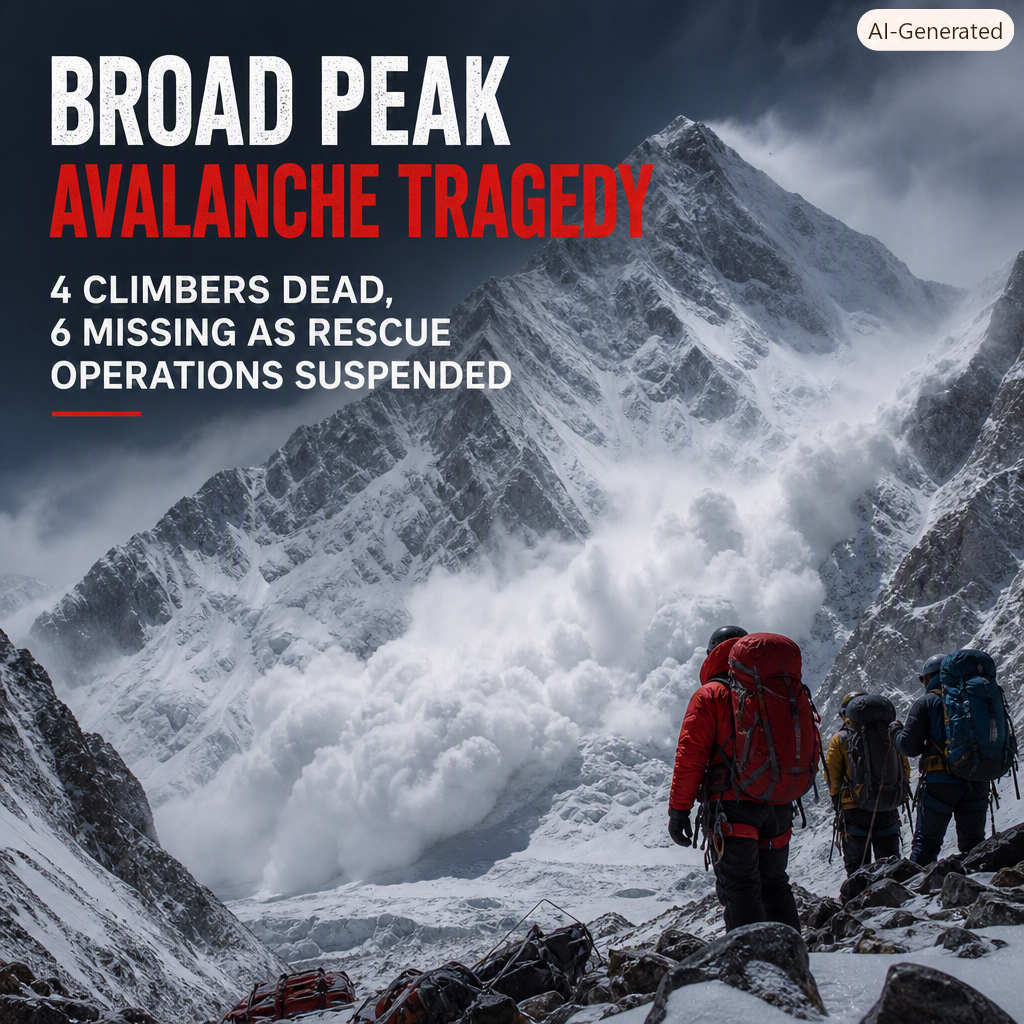
Rescue Suspended After Authorities Confirm Four Dead on Broad Peak
PAKISTAN-Rescue operations on Pakistan’s Broad Peak have been suspended after authorities confirmed that four climbers are dead following Thursday’s devastating avalanche that struck a 10‑member international expedition. The disaster has triggered one of the most difficult high‑altitude rescue missions in recent years, with six climbers still missing.
The avalanche hit the team as they were moving between high camps on the 8,047‑meter peak, cutting off all communication and scattering climbers across steep, unstable terrain. Since then, Pakistan Army aviation units, high‑altitude rescue specialists, and drone teams have been working around the clock to locate survivors.
Four Bodies Recovered, Identities Confirmed
Authorities confirmed that four bodies have been located, and three have already been recovered. The climbers whose remains were transported to Islamabad and Skardu include:
• Nathira Ahmed (Oman)
• Mallory Geis (United States)
• Pur Bahadur Gurung (Nepal)
A fourth body has been identified through drone imagery but has not yet been retrieved due to dangerous snow conditions and the risk of secondary avalanches.
Morning Update Brings New Hope
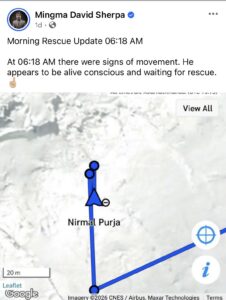
In a significant development early Saturday morning, Mingma David Sherpa a respected Nepali climber closely monitoring the rescue — reported a breakthrough. According to Sherpa, drone scans at 06:18 AM detected clear signs of movement at the GPS location of climber Nirmal “Nims Dai” Purja.
Sherpa stated that Purja appears to be alive, conscious, and waiting for rescue, based on movement indicators captured in the latest aerial footage. This marks the first hopeful sign since the avalanche struck, raising morale among rescue teams and families waiting for updates.
Six Climbers Still Missing
Despite the encouraging update, six climbers remain missing, including members from Nepal, Pakistan, China, and other countries. Their last known positions were spread across a dangerous section of the mountain heavily impacted by the avalanche.
Among the missing is Nirmal Purja, one of the world’s most accomplished mountaineers, known for summiting all 14 of the world’s highest peaks in record time. His presence on the expedition has drawn global attention to the rescue efforts.
Rescue Teams Battling Extreme Conditions
Rescue teams are facing brutal weather, unstable snow layers, and low visibility as they push toward the last known coordinates. Operations include:
• Pakistan Army helicopters conducting repeated aerial sweeps
• Ground teams climbing toward the identified location despite avalanche risk
• Drone surveillance mapping movement and locating bodies
• High‑altitude specialists preparing for potential extraction if weather allows
Officials say the mission will continue as long as conditions permit, though the terrain remains extremely dangerous.
Families and Mountaineering Community Await Updates
The global climbing community has been closely following the rescue, with messages of support pouring in from Nepal, Pakistan, Europe, and the United States. Families of the missing climbers have been in constant contact with authorities, hoping for more positive signs like the one reported by Mingma David Sherpa.
Broad Peak: A Mountain Known for Deadly Conditions
Broad Peak, the world’s 12th‑highest mountain, is notorious for sudden weather shifts, deep snowfields, and avalanche‑prone slopes. Climbers often describe it as one of the most technically demanding peaks in the Karakoram range.
This tragedy has once again highlighted the extreme risks faced by high‑altitude climbers and the challenges of conducting rescue operations above 7,000 meters.